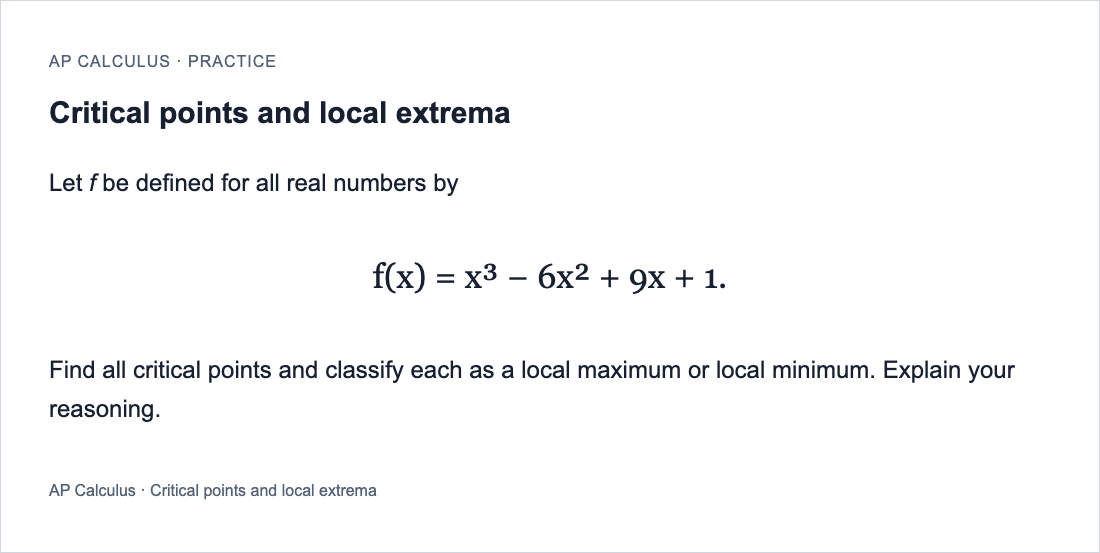
how do I find all the critical points and determine whether each is a local maximum or a local minimum? Could you show the reasoning step by step?
Answer 1
**The critical points are (1, 5), a local maximum, and (3, 1), a local minimum.** Here's how to find and classify them.
### 1. Identify the critical numbers
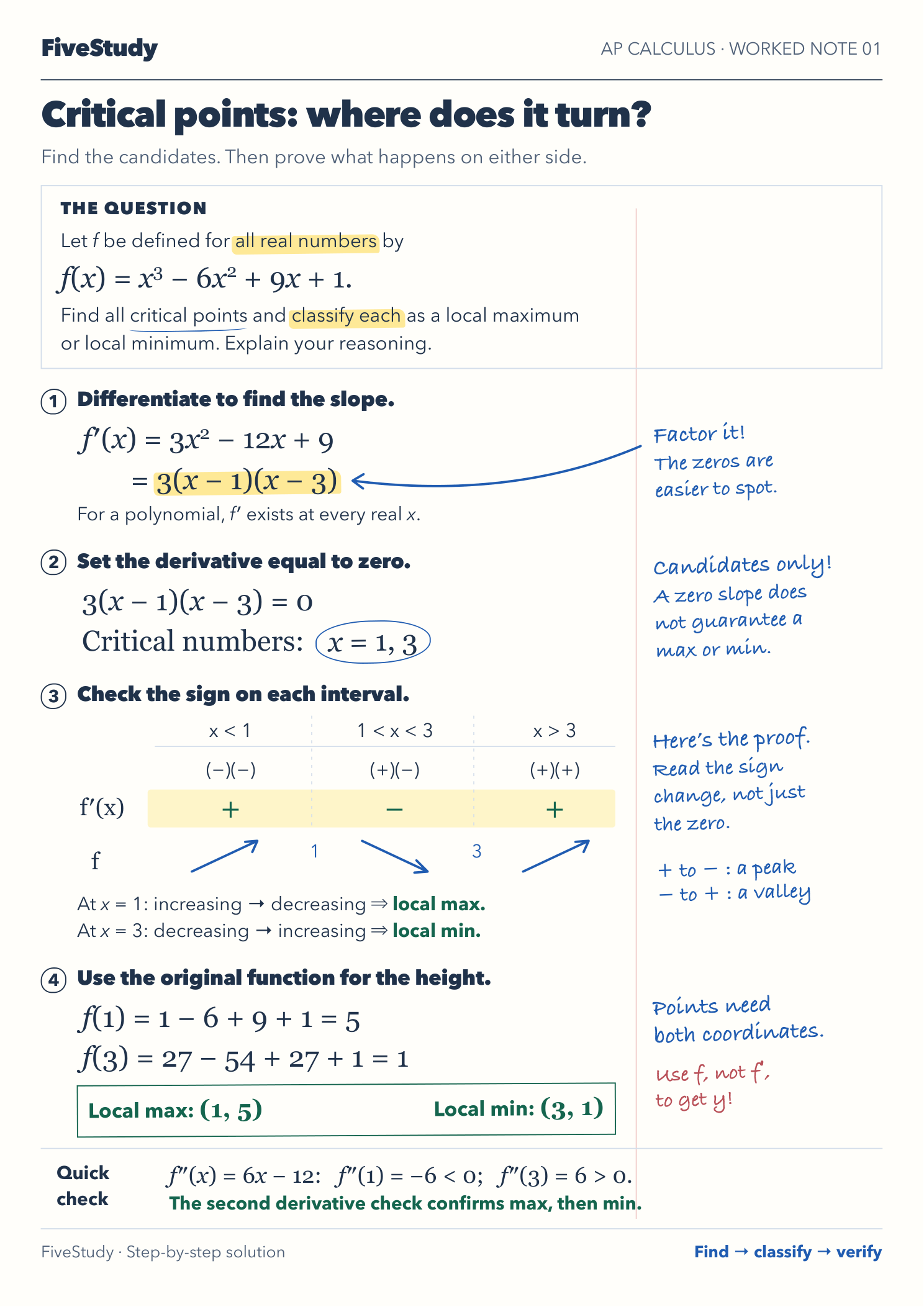
We need the x-values where f′(x) = 0 or the derivative does not exist. Since f is a polynomial, its derivative exists for every real x. So we only need to solve f′(x) = 0.
### 2. Differentiate and factor
f′(x) = 3x² − 12x + 9
= 3(x² − 4x + 3)
= **3(x − 1)(x − 3)**.
Setting this equal to zero gives **x = 1 and x = 3**.
Teacher note: a zero derivative identifies a candidate—it does not, by itself, prove that the point is a maximum or minimum.
### 3. Check how the derivative changes sign
- For x < 1, both factors are negative, so f′(x) > 0: f is increasing.
- For 1 < x < 3, the factors have opposite signs, so f′(x) < 0: f is decreasing.
- For x > 3, both factors are positive, so f′(x) > 0: f is increasing.
At **x = 1**, the function changes from increasing to decreasing: a **local maximum**.
At **x = 3**, it changes from decreasing to increasing: a **local minimum**.
### 4. Find the coordinates and verify
f(1) = 1 − 6 + 9 + 1 = **5**.
f(3) = 27 − 54 + 27 + 1 = **1**.
So the critical points are **(1, 5), local maximum**, and **(3, 1), local minimum**.
Quick independent check: f″(x) = 6x − 12. Then f″(1) = −6 < 0 confirms the local maximum, while f″(3) = 6 > 0 confirms the local minimum. There are no other critical points because the derivative exists everywhere and has only these two zeros.
### Annotated teacher-style note
[Open the annotated note at full size](/objects/uploads/cad4cb83-005a-4253-82a6-d05aefe28e9a)